Destination · 32 min read
Clothing-Optional Germany: The Complete Guide to FKK Beaches, Lakes & Naturist Culture
Germany invented modern naturism. Freikörperkultur — FKK — has been part of mainstream German life since the 1890s, survived two world wars and a national partition, and remains the only naturist tradition in Europe with continuous popular practice for over a century. Here's where to go, what to expect at a German FKK beach or sauna, and what the law actually says.
Modern naturism is a German invention. The word Nacktkultur — “naked culture” — was coined in 1903 by Heinrich Pudor, whose 1898 book Nackende Menschen und der Jubelruf der Zukunft (“Naked Humans and the Future’s Cry of Triumph”) laid out the philosophical case for non-sexual public nudity that has shaped every European naturist movement since. By 1906, organised FKK (Freikörperkultur — “free body culture”) clubs were operating in Berlin and Hamburg. By the late 1920s, Adolf Koch’s working-class FKK schools had thousands of members across Berlin, and Hans Surén’s 1924 Der Mensch und die Sonne sold over 250,000 copies — one of the bestselling German books of the Weimar era.
That tradition has been continuous. It survived the Third Reich (which alternately suppressed and co-opted FKK), the post-war partition (during which the German Democratic Republic developed the most thoroughly nude beach culture in Europe), and reunification (after which the East German default and the West German organised club tradition merged into the contemporary FKK landscape). Today Germany has more designated FKK locations than any other country in the world, and the cultural baseline — unlike anywhere else in Europe — treats public nudity at a designated location as completely unremarkable.
This guide covers the four major regional clusters where German FKK is concentrated: the Berlin lake belt, the Baltic coast in Mecklenburg-Vorpommern and Schleswig-Holstein, the North Sea islands of Lower Saxony, and the inland lakes of Bavaria, Brandenburg, and Saxony. It closes with German sauna culture, the legal framework, and practical advice for first-time visitors.
Berlin and the Berlin lake belt
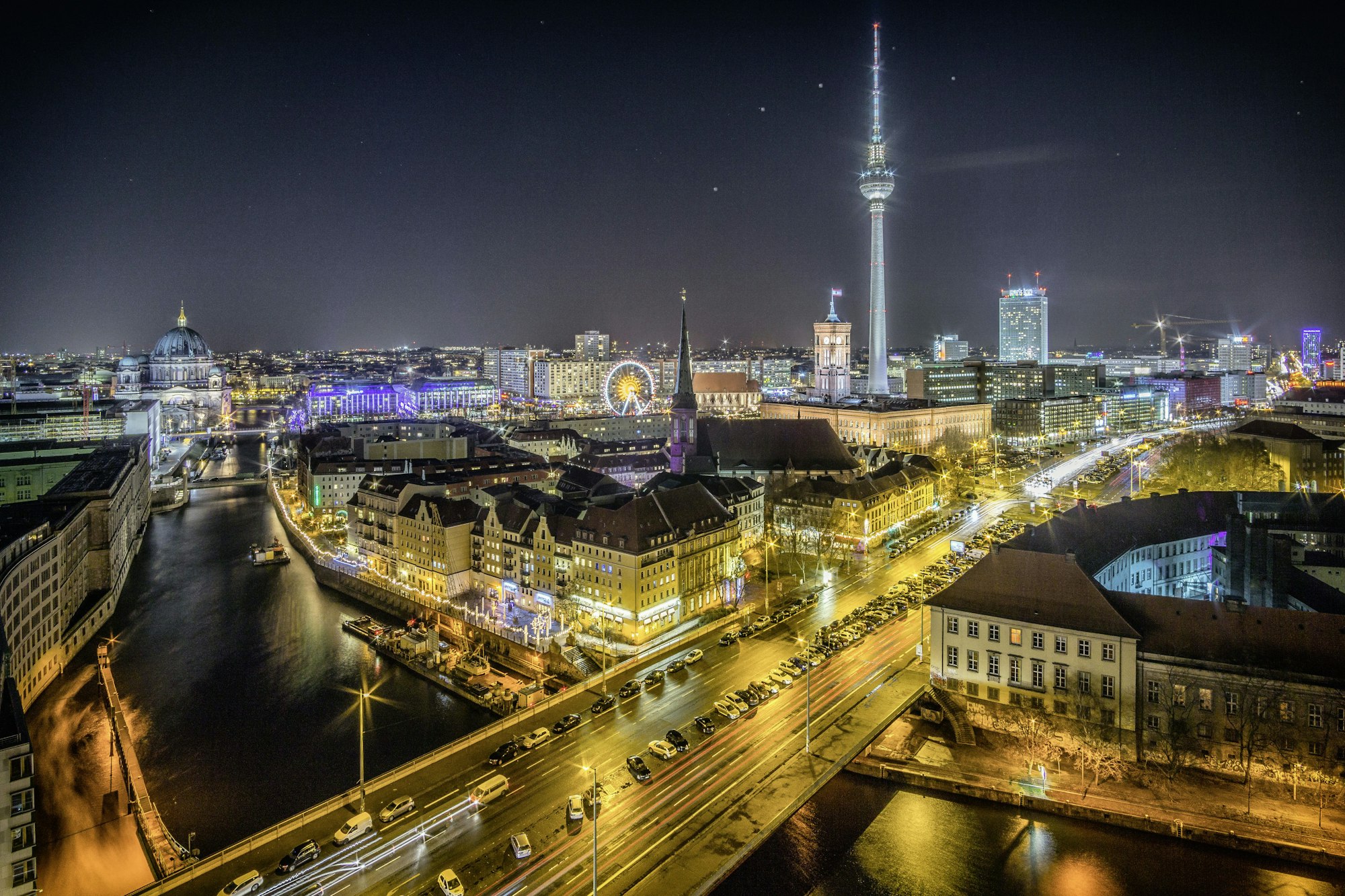
Berlin is the FKK capital of Europe. The city sits in the middle of a lake belt — glacial-era waters running north and west of the metropolitan area — and a string of those lakes have hosted continuously operating FKK sections since the 1920s. All four of the major Berlin FKK locations are accessible from the city centre by S-Bahn or U-Bahn in under an hour.
Strandbad Wannsee is the historical anchor. The Strandbad (“bathing beach”) opened in 1907 as a Wilhelmine-era public health project — one of the first municipal lakeside swimming facilities in Europe — and was rebuilt in 1929–30 as a Bauhaus-influenced social-democratic showpiece that holds the same form today. The complex includes a kilometre of sandy beach, the historic 1929 building (still operating), kiosks, lockers, and a designated FKK section at the northern end. Wannsee is the introduction-grade Berlin FKK experience: full infrastructure, mainstream crowd, easy S-Bahn access (Wannsee station, then a short walk).
FKK Strandbad Müggelsee is the East Berlin counterpart. The Müggelsee is the largest lake in Berlin (7.4 km²), and the FKK Strandbad on its southern shore has operated continuously since the GDR era. The character is more local, less touristy than Wannsee, and the East Berlin FKK heritage runs deep — under the GDR this was where Friedrichshain and Lichtenberg families spent their summer weekends. Today the crowd is mixed-generation and unfailingly relaxed. S-Bahn access via Friedrichshagen.
Krumme Lanke is the locals’ favourite. It’s a smaller lake just south of the Grunewald forest, accessible via U-Bahn (Krumme Lanke station, then a 10-minute walk), with no formal Strandbad infrastructure — just a forest-fringed shore and a long-established FKK section on the eastern bank. The character is quieter and more residential than Wannsee. FKK at Krumme Lanke has been continuous since the 1920s.
Teufelssee (“Devil’s Lake”) sits inside Grunewald forest west of the city. It’s small, fully surrounded by woods, and has a particularly Berlin character — alternative, queer-friendly, low-key, the place where younger Berliners go when Wannsee feels too mainstream. There’s no infrastructure: bring everything you need. Access is by foot or bike from Grunewald or Heerstraße S-Bahn.
FKK-Strand am Flughafensee is the Tegel district lake — formed in the basin north of the former Tegel airport — with a designated FKK section and a more working-class North Berlin character.
What Berlin offers, that no other capital in Europe offers, is the casual integration of FKK into the city’s everyday public life. A hot July day in Berlin, the FKK sections at Wannsee and Müggelsee are crowded with families, retirees, students, and office workers on lunch breaks. There’s no sense of transgression, no novelty, no political edge. It’s just where people go to swim. The 2023 ruling by the Berlin Senatsverwaltung that legalised all-gender topfreedom in public swimming pools — meaning anyone of any gender can swim topless at any public Berlin pool — is the logical extension of a city culture that has treated the body as unremarkable for a hundred years.
The Baltic coast: Mecklenburg-Vorpommern and Schleswig-Holstein
The German Baltic coast is the historical heartland of mass-popular FKK. From the Schleswig-Holstein border with Denmark, around the Bay of Lübeck, past the islands of Fehmarn, Rügen, Usedom, and Hiddensee, virtually every developed beach has an FKK section — and in many cases the FKK section is larger than the textile one. This is the German FKK landscape at its most fully realised, with a continuous tradition stretching back to the 1920s and dramatically intensified during the GDR era.
Mecklenburg-Vorpommern holds the densest concentration. The state has 23 documented locations in our catalogue, spread across the islands of Rügen and Usedom, the Darß-Zingst peninsula, the Wismar Bay coast, and the inland Mecklenburg Lake District.
FKK Strand Markgrafenheide, just east of Rostock and Warnemünde, is one of the most accessible Baltic FKK beaches for international visitors — easy reach from Berlin by train (about 3 hours), with a long, broad sandy beach and a multi-kilometre FKK section. The FKK section of the Warnemünde Strand itself is the urban-resort counterpart, with full beach infrastructure on the western Strandpromenade.
The island of Usedom, shared with Poland, has a continuous FKK tradition — the resort towns of Heringsdorf, Ahlbeck, and Bansin (the “Three Imperial Spas” of the Wilhelmine era) all have established FKK sections at their eastern ends. The Polish island side, around Świnoujście, was historically German and shares the cultural pattern.
The island of Rügen — Germany’s largest island — has FKK beaches at Binz, Sellin, Göhren, and the Schaabe (the long sand spit connecting Rügen to the smaller island of Jasmund). The Schaabe in particular is a 12-kilometre arc of beach that runs from textile at the developed ends to FKK in the long middle stretch.
The Darß-Zingst peninsula in the Mecklenburg-Vorpommern Western Pomerania National Park is the more wild end of the Baltic FKK spectrum — long stretches of dune-backed beach, fewer resorts, an established FKK character that goes back generations. The towns of Prerow, Wieck, and Zingst all have FKK sections.
Schleswig-Holstein (24 documented locations) holds the western Baltic. The most famous beach in this stretch is Buhne 16 on the island of Sylt — a section of beach north of the town of Kampen marked by groyne (“Buhne”) number 16. Buhne 16 was the celebrity FKK beach of the 1970s and 1980s, where the West German film, fashion, and political scenes converged in summer. It still operates today, and while its 1970s celebrity-magnetism has faded, the FKK tradition continues. Abessinien FKK Strand at the northern end of Sylt near List is the other major Sylt naturist beach.
Inland on the Schleswig-Holstein coast itself, the FKK-Strand Timmendorfer Strand and FKK-Strand Sandgut Scharbeutz are the major resort-town FKK sections in the Lübeck Bay, with full infrastructure and easy reach from Hamburg.
What unifies the Baltic stretch is its multi-generational family character. The FKK section is where the grandparents take the grandchildren. The cabanas (Strandkörbe — the woven beach baskets that are an icon of the German Baltic) are rented by the day or week. The beach character is unhurried, social, and completely unremarkable to participants. For international visitors who arrive with anxiety about being “the only one,” the Baltic FKK beach is the most settling possible introduction.
The North Sea: Lower Saxony and East Frisian islands
The North Sea coast of Lower Saxony — and especially the chain of East Frisian Islands (Ostfriesische Inseln) that protect the mainland — holds the other major German seaside FKK tradition. The islands of Borkum, Juist, Norderney, Baltrum, Langeoog, Spiekeroog, Wangerooge, and Memmert run in an arc from the Dutch border eastward, separated from the mainland by the Wadden Sea (a UNESCO World Heritage tidal area).
Naturist beaches on the East Frisian Islands developed in the late nineteenth century alongside the broader German bathing culture, and the islands’ isolated character — accessible only by ferry, no through-traffic of cars in most cases — gave the FKK tradition particularly deep roots. The Nudist beach DLRG at Borkum is the historical anchor: Borkum is the westernmost and largest of the East Frisian Islands, the DLRG (German Life Saving Association) beach section has a continuous naturist tradition, and the island culture — quieter than Sylt, less celebrity-driven — preserves a distinctly North Sea FKK character.
Norderney, Spiekeroog, and Langeoog have their own FKK sections — generally at the eastern or western ends of the developed beach stretches, where the dunes give way to wilder shore. The character throughout the East Frisian chain is restrained, family-oriented, and weather-respectful: the North Sea is cold (water rarely exceeds 18°C even in August), the wind constant, and the FKK day usually involves a Strandkorb or dune shelter as much as the water itself.
The mainland North Sea coast itself — particularly in East Frisia (Ostfriesland) and around the Jade Bay — also has FKK sections at developed beaches, though the islands are the historical centre. The FKK Strand an der Knock on the East Frisian mainland is one of the established mainland coastal FKK locations.
Inland lakes: Bavaria, Brandenburg, Saxony, and beyond
Germany’s freshwater FKK network is as developed as its coastal one. Three regional clusters dominate.
Bavaria (24 documented locations) is the largest single-state inland network, centred on the lakes of the Bavarian Alpine foreland and the rivers that drain them. Feringasee is the most famous Munich-area FKK lake — a former gravel pit converted into a recreation lake in the city’s northern outskirts, with a designated FKK section that draws a large urban Munich crowd. The lake is easily reached by U-Bahn (Unterföhring or Garching). The FKK-Zonen an der Isar at Maria Einsiedel in southern Munich is the river-FKK counterpart — a stretch of the Isar river within the city limits with designated FKK riverbank zones, part of a broader Munich tradition of river bathing that goes back to the nineteenth century.
The Eibsee at the foot of the Zugspitze, the Walchensee and Kochelsee in the Alpine foreland, and the Tegernsee all have FKK areas of varying formality — sometimes designated, sometimes operating under long-standing local custom. The Bavarian inland FKK landscape is less uniform than the Baltic but more visually dramatic; an Alpine FKK afternoon on the Eibsee with the Zugspitze rising over the water is one of the more striking naturist experiences in Europe.
Brandenburg (12 documented locations) surrounds Berlin and effectively functions as the city’s extended lake belt. The state holds dozens of former gravel pits, lignite-mining reservoirs, and natural glacial lakes, many with established FKK sections. The FKK-Strand Talsperre Spremberg in southern Brandenburg is one of the larger reservoir-FKK locations; FKK Strand Motzen south of Berlin is a popular weekend destination from the city. The character throughout Brandenburg is straightforward inland-lake FKK — sandy beaches, calm fresh water, FKK as the default rather than the exception.
Saxony (13 documented locations) holds the southeastern inland-lake network, including reservoirs in the Erzgebirge foothills and large lakes around Dresden and Leipzig. The Talsperre Bautzen FKK beach and Pohl dam are established designated locations. The Leipzig “New Lake District” (Neuseenland) — a chain of former open-pit lignite mines that have been flooded and converted into recreation lakes over the past two decades — has emerged as a new major FKK landscape, with the Cospudener See and Markkleeberger See holding designated FKK sections that draw large crowds from the city.
Other states (Hessen, Baden-Württemberg, Lower Saxony interior, North Rhine-Westphalia, Thuringia, Saxony-Anhalt) each hold significant numbers of inland FKK lakes — see the Germany directory for the full list of 172 catalogued locations.
Sauna culture
No discussion of German naturism is complete without sauna. German sauna culture is uniformly clothing-free, mixed-gender, and deeply embedded in the country’s everyday wellness practice. Every German town of any size has a Therme or Saunalandschaft — a public sauna facility — and the cultural rule is identical everywhere: no swimsuits in the sauna.
The reason is partly hygiene (synthetic swimsuit fabric traps sweat and bacteria in the high heat) and partly cultural (the sauna is understood as a body-restoration practice that excludes the sexual coding of clothing). You will bring two towels: one large one to sit on (the sauna wood doesn’t touch your skin), and one smaller one to dry off between rooms. You will be entirely nude. So will everyone else. The atmosphere is unfailingly civil and the practice unmistakably non-sexual.
The centrepiece of the German sauna experience is the Aufguss — the ritual in which a sauna attendant enters the hot room, pours scented water (eucalyptus, citrus, mint, pine) over the heated stones, and uses a large towel to circulate the steam through the room. An Aufguss runs roughly fifteen minutes, during which the temperature can rise above 100°C and the experience becomes intense, ritualised, and theatrical. It’s the closest thing in European wellness culture to a ceremonial practice, and good Aufguss-Meister are minor celebrities.
A few destination saunas worth seeking out:
Therme Erding outside Munich is the largest sauna complex in Europe — 27 saunas across multiple buildings, a tropical-themed pool landscape, the works. It’s the maximalist German sauna experience. The complex has both textile and FKK sauna sections; the dedicated sauna landscape is FKK-only by design.
Friedrichsbad Baden-Baden is the historic counterpart. Opened in 1877, the Roman-Irish bathing programme runs through seventeen stations of increasing heat, scrub, steam, immersion, and rest, all clothing-free and mixed-gender (with a few gender-segregated days for those who prefer that). Mark Twain wrote of Friedrichsbad in 1880 that “after ten minutes you forget time; after twenty minutes, the world.” It remains the most ceremonial German sauna experience available.
Tropical Islands in Brandenburg, an hour south of Berlin, is the tropical-resort-style sauna destination — built inside a vast former airship hangar, with the largest indoor rainforest in Europe and a full FKK sauna section.
Hundreds of municipal Thermen and hotel spas across the country offer the same baseline experience. If you’re visiting Germany and have never done German sauna, this is one of the most distinctive cultural practices you can engage with.
Legal framework
The German legal framework around public nudity is the lightest in Europe. There is no specific anti-nudity statute in the federal Strafgesetzbuch (Criminal Code). The catch-all administrative provision — § 118 of the Ordnungswidrigkeitengesetz (Administrative Offences Act) — addresses “grob ungehörige Handlung, die geeignet ist, die Allgemeinheit zu belästigen” (“grossly improper behaviour suitable to disturb the general public”), with a maximum €1,000 fine. The provision is rarely applied, and at designated FKK locations it has effectively no reach because the location designation itself negates the “disturbance” element.
Each of the 16 Bundesländer has its own Polizeiverordnungen (police ordinances) and Landesnaturschutzgesetze (state nature-protection laws), some of which contain specific FKK provisions. In general these designate certain locations as FKK and others as textile, but the structure is permissive rather than restrictive — designations expand the FKK network, they don’t shrink the area where nudity is acceptable.
The 2023 Berlin development is the most significant recent expansion. The Berlin Senatsverwaltung für Inneres und Sport — the city-state’s interior and sport administration — issued a ruling in spring 2023 establishing that any person of any gender may swim topless in any of Berlin’s municipal swimming pools, on equal-treatment grounds. The decision resolved a years-long discrimination case brought by a woman who had been ordered to cover up at a public pool. The Berlin ruling has not yet been replicated in other Länder, but it has prompted similar discussions in Hamburg, Bremen, and other municipalities.
The broader continental-European trend has been toward formal codification of FKK protection: France’s Article 222-32 of the Penal Code requires sexual intent for prosecution, Spain’s exhibitionism statute has the same requirement, and Germany’s § 118 OWiG framework is even lighter. For the full comparison across all jurisdictions, see our public nudity laws by country guide.
A note on photography: photographing other people at FKK locations is prohibited under federal law (§ 201a of the Strafgesetzbuch, “Verletzung des höchstpersönlichen Lebensbereichs durch Bildaufnahmen”) with penalties significantly more serious than any anti-nudity provision. The cultural rule and the legal rule align: cameras are unwelcome at FKK locations.
Practical tips for visitors
A few notes from years of FKK observation that may save you a small embarrassment:
Look for the FKK sign. Designated locations are virtually always signposted (FKK or Naturisten at the trailhead, beach access, or shore). If you don’t see one, assume textile. German FKK culture is location-specific, not universal — taking your clothes off at an undesignated lake will draw attention.
Bring two towels. One large for sitting on, one for drying. This applies at lakes and beaches as well as saunas. Towel-on-shared-surface is the universal hygiene rule.
Don’t carry a camera into an FKK area. Photographs of identifiable people at FKK locations are illegal under § 201a StGB. Even a phone visible in your hand will draw frowns. Leave the camera in the bag.
Sauna etiquette: shower first, naked in the room, towel under your body. Walking into a German sauna with a swimsuit on will get you politely directed out. Walking in with a folded towel covering your body is fine but unusual. The civilian expectation is fully nude, towel underneath, water-glass-and-magazine optional.
FKK vocabulary: FKK-Strand (FKK beach), Naturisten-Strand (naturist beach, less common in Germany than FKK), Strandbad (bathing beach with infrastructure), Strandkorb (the woven Baltic beach basket), Saunalandschaft (sauna complex), Aufguss (sauna ritual), Textilstrand (textile/non-nude beach). Frei in this context means “free” as in “free use” — Freikörperkultur literally is “free-body culture.”
Seasonality: May through September is the Strandbad season at most German lakes. The Baltic is reliable from June to mid-September; the North Sea is colder and the swimming window is narrower. Sauna is year-round, and the German sauna ritual is particularly resonant in winter — the contrast between hot room and cold plunge or outdoor air is the point.
First-timer’s pick: if you’ve never done FKK and have a single day in Germany, take the S-Bahn from central Berlin to Wannsee, walk fifteen minutes to the Strandbad, pay the modest entry fee, and go to the designated FKK section at the northern end. Bring a book. Stay for an afternoon. You’ll have done a hundred-and-twenty-year-old German cultural practice at its most accessible location, and you’ll understand on a different level why the country’s relationship with the body is what it is.
Related guides
Germany sits at the centre of the continental European naturist world. For comparison and broader context, see our cornerstone guides for the neighbouring traditions:
- Clothing-Optional France — the largest organised naturist network in the world, with Cap d’Agde, CHM Montalivet, and Île du Levant
- Clothing-Optional Spain — Mediterranean and Atlantic naturism with no statutory restriction
- Clothing-Optional Croatia — the Adriatic resort tradition, anchored by Koversada (the world’s first dedicated naturist resort, 1961) and the summer destination of generations of German FKK visitors
- Clothing-Optional Italy — the most dramatic Mediterranean naturist landscapes, anchored by the 2000 Cassation ruling that mainstreamed toplessness nationwide
- Clothing-Optional Australia — the English-speaking world’s most formally designated naturist network
- First Time at a Nude Beach — the beginner’s introduction to FKK, naturism, and clothing-optional practice
- Public Nudity Laws by Country — the comparative legal framework